A business can operate through social media, directories, marketplaces, and word of mouth without having a website. The tradeoff is that important information stays scattered across platforms the business does not control.

A website gives customers one stable place to understand the offer, evaluate proof, and take the next step. It can support search visibility, lead collection, customer service, and measurement, but none of those outcomes happens automatically. The value comes from useful content, clear conversion paths, and ongoing improvement.
Business Website Benefits at a Glance
A well-planned business website can:
- Answer common questions and collect enquiries when you are unavailable
- Give potential customers one place to verify services, work, reviews, and contact details
- Create dedicated pages for products, services, and locations that search engines can crawl and potentially index
- Turn traffic from search, social media, referrals, and ads into a clear next step
- Give search and AI systems a consistent first-party source about the business
- Show which pages and channels contribute to enquiries when measurement is configured
- Reduce dependence on third-party platforms the business does not control
Why a Website is a Core Business Asset in 2026
A real business asset does three things: it keeps working when you’re not working, it becomes more valuable over time, and it reduces risk by giving you more control.
That’s exactly what a website can be.
Unlike a social profile, a website on your own domain gives you direct control over the structure, messaging, customer journey, and information people see first. You still depend on a registrar and hosting provider, but you can move the site and preserve its content.
A good website can answer questions, demonstrate credibility, collect enquiries, and support sales while you are doing other work.
The more you improve it with stronger pages, better SEO, clearer messaging, and better conversion paths, the more useful it can become. Unlike a short-lived post or campaign, a useful page can continue serving customers and attracting qualified visits over time.
For small businesses especially, this matters a lot. You may not have the brand recognition or marketing budget of bigger competitors, but a strong website helps you look credible, clear, and easy to choose.
Advantages of Having a Business Website
The benefits of a business website are practical: less repetitive admin, clearer lead paths, more proof for customers to evaluate, and more opportunities to be discovered.
Here are some of the real benefits a website can bring to your business:
A Website Saves Time & Reduces Repetitive Work
How many times a week do you answer the same questions?
“What’s included in your service?”
“How do I book?”
“What’s your pricing?”
If you’re answering each of those by phone, email, DM, or in person, that’s hours of your week gone. Hours you could spend on actual work, or your hobbies.
A well-built website can handle much of that routine work. An FAQ answers common questions, service pages explain the offer, and booking or enquiry forms make the next step available without a phone call.
For a small team, those time savings can be meaningful. Every recurring question answered on the site is one less conversation you have to repeat.
The amount of time saved depends on the business and how well the site connects to its booking, enquiry, payment, or customer-management workflow.
Collect and Qualify Leads Outside Business Hours
Social media can attract attention. A website gives that attention a clear next step.
A proper business website doesn’t rely on “DM me” as the main conversion strategy. It gives people a clear next step: book a call, request a quote, or buy the product. And it keeps doing that even when you’re not online.
That reduces how often you need to be available for the first stage of a sale: the site can explain the offer, set expectations, and help visitors decide whether it fits.
Clear service, pricing, location, and process information helps visitors decide whether they are a good fit before contacting you.
And when paired with SEO, your website doesn’t just sit there looking pretty. It helps attract people who are already searching for exactly what you offer.
Build Business Credibility & Trust
When choosing a builder, consultant, or local service, a potential customer may compare photos, pricing, reviews, service details, and recent work before making contact. A website puts that evidence in one place.
A professional website can help visitors verify that a business is active and assess whether it is a credible option. It is not proof by itself: genuine reviews, detailed case studies, named people, certifications, clear contact information, and examples of completed work are what make the claim believable.
Presentation also affects first impressions. In a Stanford study of 2,684 people, visual design was the website feature most often mentioned when participants explained credibility judgments. The study was conducted in 2002 under low-engagement test conditions, so it is directional evidence rather than a current conversion benchmark.
For a smaller or less familiar company, the website may carry much of that first impression. Clear proof helps a visitor evaluate the business instead of relying on claims alone.
Create More Opportunities to Appear in Search
People search for services with queries such as “car mechanics near me” and “web design services for small business.” A verified Google Business Profile can appear in Search and Maps, so a local business is not invisible just because it lacks a website.
A website expands the opportunity by creating dedicated pages for services, products, locations, questions, and proof. Google can discover, crawl, analyze, and potentially index those pages, although Google does not guarantee crawling, indexing, or rankings.
SEO helps search engines access and understand those pages and can improve their visibility. It includes useful page content and a sound technical foundation, supported where relevant by accurate local listings, citations, and links from other sites.
Business size alone does not determine local rankings. Google says local results are mainly based on relevance, distance, and prominence, and that complete, accurate business information can help local visibility. A smaller company can compete when its pages are relevant, accessible, and supported by consistent local information, but there is no guaranteed position.
One example from our work is Gridinta. The engagement combined a bilingual website rebuild, moving service information from PDFs to indexable pages, technical SEO, and more than 40 articles. The Search Console report below shows 3.38K organic search clicks and 410K impressions with a custom Web search date range selected. This documents the combined program, not the effect of a website in isolation, and it is not a guarantee of similar results. Read the full Gridinta case study.
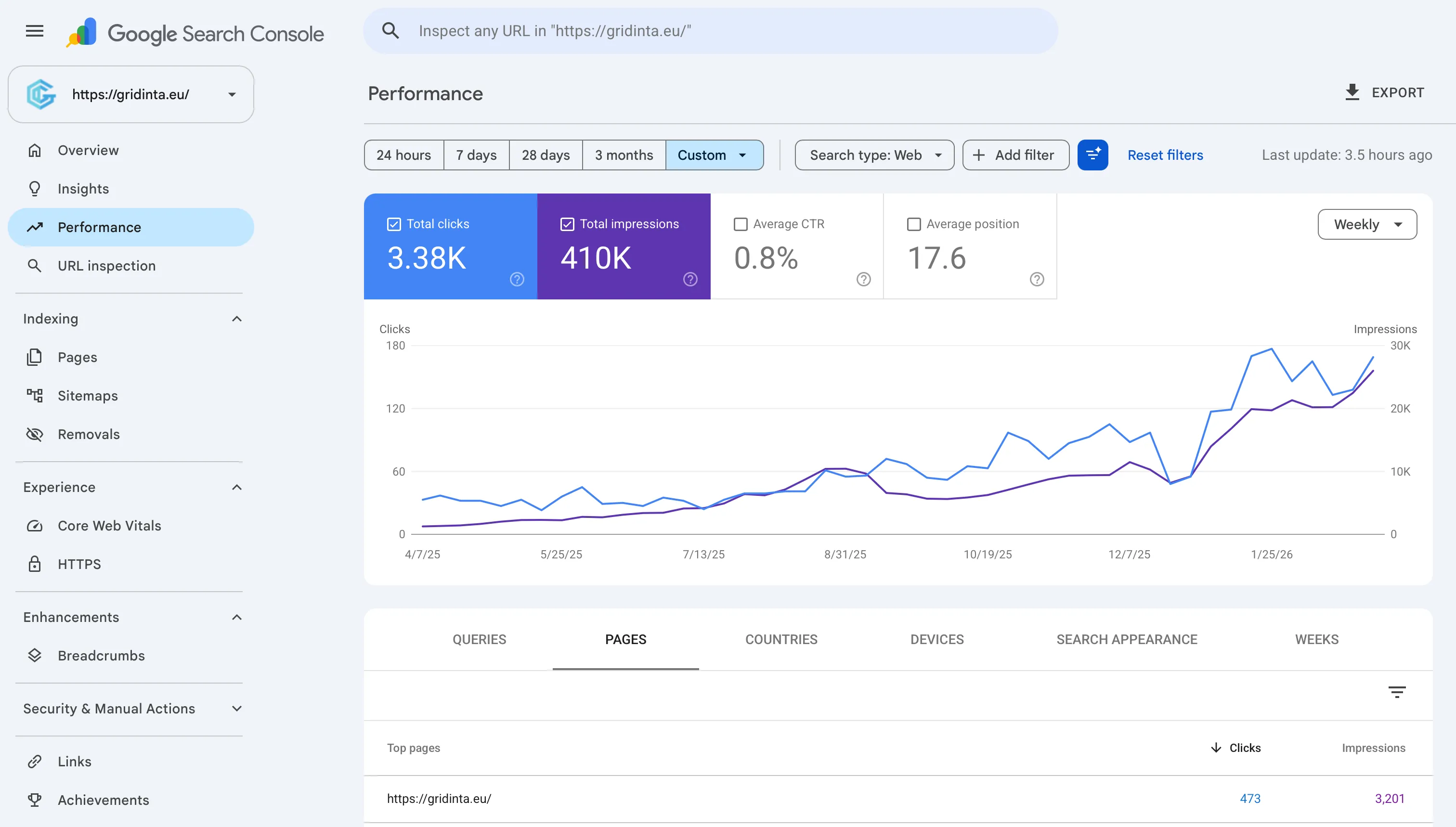
The current verified window, 30 September 2025 to 29 September 2026, recorded 6,640 Search Console clicks. The case study separates this dated total from the earlier archived report.
Source: Google Search Console for gridinta.eu, Search type: Web, custom date range, shown weekly.
Create an Eligible Source for AI Search
A website gives search and AI systems first-party pages about what a business does, who it serves, and where it operates. Scattered or outdated profiles make it harder to establish one consistent description.
That does not guarantee a mention, recommendation, or citation. Google says a page must be indexed and eligible to appear in Search with a snippet before it can be eligible as a supporting link in AI features; its standard SEO guidance still applies, with no special AI schema required. OpenAI similarly says public sites can be included in ChatGPT search when they allow OAI-SearchBot, but inclusion and ranking are not guaranteed.
How a website helps AI find, understand, and recommend your business:
- Detailed service pages that clearly describe what you offer
- FAQ sections that answer real customer questions
- Case studies that show proof of your expertise
- Structured data that accurately describes the visible page content; it can help search systems interpret a page, but no special schema guarantees inclusion
Preparing and measuring a site for AI-assisted discovery is often called Generative Engine Optimization, or GEO. It builds on the same foundation: accessible pages, useful original content, clear internal links, and accurate structured data. Our AI search visibility checker reviews that public technical foundation; it does not measure or promise live citations.
Turn Visitors into Clients with Better Conversion Paths
A website gives you control over the customer journey.
On social media, people bounce around. They get distracted. They click, leave, forget.
On a website, you can guide the path: a visitor lands on a service page, understands the offer, sees proof, gets clarity on pricing or process, then takes the next step.
Both presentation and clarity matter. Does the visitor quickly understand what you do? Can they get essential answers without calling you? Is there enough proof to feel comfortable taking the next step?
A clear path can improve the likelihood of conversion, but the effect should be measured rather than assumed. Test changes such as a faster load time, clearer headline, shorter form, or stronger proof, then compare completed enquiries or sales. You can use our website performance checker and mobile-friendly checker to identify two common sources of technical friction before testing the message and offer.
That is the practical advantage: the website can connect attention to a measurable action.
Make Smarter Business Decisions with Website Data
With consent-aware analytics and conversion tracking, a website can show aggregate patterns such as pages viewed, traffic sources, engagement, and completed actions.
It is not a complete trail of every visitor. Consent choices, blockers, implementation gaps, and attribution rules all affect the data. Google explains that with basic consent mode, its tags send no data when a visitor does not consent; in other setups, some measurement gaps may be modeled. The right goal is useful, privacy-conscious evidence, not perfect surveillance.
Within those limits, analytics can still support better decisions. If tracked enquiries show that one service page contributes most leads, you can investigate why and decide whether to invest more. If many measured sessions reach a contact page but few complete the form, that is a prompt to test the page, form, or offer.
Do I Need a Business Website If I Have Social Media?
Often, yes, but not because social media is useless. The two channels serve different roles.
Social platforms control their algorithms, account rules, and distribution. Reach can change, and an account restriction can temporarily remove access to an audience you built there.
A website on your own domain gives you more control over the content, design, conversion paths, and measurement setup. You do not own search rankings or all visitor data, and you still depend on a registrar and hosting provider, but you can move the site and preserve its content more easily than a social profile.
The strongest setup uses both: social media supports discovery and conversation, while the website provides a stable destination where visitors can evaluate the offer and take action.
How Much Does a Business Website Cost?
How much a business website costs depends on your business, the type of website you need, the number of pages, and what extra features are required. A simple one-page site costs less than a multi-page website with a booking calendar, payments, or other custom features.
Not sure what the process looks like? See our guide to how web design projects work. Wondering about custom vs template options? We break that down too.
At Web Aloha, our web design services currently start at $777 for a one-page website, with larger multi-page packages at $999 and $1999 depending on the scope and goals. The service page lists what each package includes.
Whether a website pays for itself depends on project cost, qualified traffic, conversion rate, gross profit per customer, and ongoing expenses. Track enquiries and sales so you can calculate the return instead of assuming it.
Frequently asked questions
Do I really need a website for my business in 2026?
For most businesses, a website is worth having because it creates one stable place to explain the offer, show proof, and give customers a clear next step. Some businesses can operate through referrals, marketplaces, social media, or a Google Business Profile, but those channels provide less control over how information is presented and how enquiries are handled.
What are the main benefits of having a business website?
The main benefits are practical: one controlled place to present the business, proof that customers can evaluate, dedicated pages for search, fewer repetitive questions, clearer lead and sales paths, useful measurement, and less dependence on third-party platforms.
Can a small business survive without a website?
Yes. Some small businesses operate through referrals, marketplaces, social media, or a verified Google Business Profile. The tradeoff is less control and more scattered information. A website becomes especially useful when customers compare options, research services, or need a clear way to enquire, book, or buy.
Does a website help a business get more leads?
It can. A good website gives people a clear next step: book a call, request a quote, send an enquiry, or buy a product. Clear service, pricing, location, and process information can also help visitors decide whether they are a good fit. Results still depend on qualified traffic, the offer, the user experience, and follow-up.
How does a website save time for a small business owner?
A website can answer common questions before people contact you. It can explain services, show pricing or pricing ranges, handle bookings, collect enquiries, and automate confirmations. The amount of time saved depends on the business and how well those workflows are set up.
Does a website improve trust and credibility?
It can help visitors evaluate whether a business is credible, but a website is not proof by itself. Clear service details, named people, genuine reviews, case studies, certifications, contact information, and recent work give customers evidence they can assess.
Can a website help my business rank on Google?
A website creates dedicated pages that Google can crawl, understand, and potentially rank for service-related searches. It does not guarantee indexing or rankings, and eligible local businesses can also appear through a Google Business Profile. The website expands how much useful first-party information you can publish and optimize.
Can a website help my business show up in AI search results?
It can make a business eligible to appear as a source, but it cannot guarantee a mention or citation. Google says its AI search features use the same baseline technical requirements as Search and do not require special AI schema. Clear, accurate service pages, case studies, and contact details give search and AI systems useful first-party information to retrieve.
Do I still need a website if I already have social media?
A website is useful if you want more control over your content, customer journey, and measurement. Social media can support discovery and conversation, while a website provides a stable destination for evaluating the offer and taking action. You still depend on a domain registrar and hosting provider, but the site is more portable than a social profile.
How much does a business website cost?
It depends on your business, the type of website you need, the number of pages, and what extra features are required. A simple one-page website costs less than a multi-page site with bookings, payments, ecommerce, or custom functionality. Our website design packages currently start from $777.