
Folk songs & sutartinės
Lyrics, variants, meanings, symbols, and Lithuania’s UNESCO-recognized multipart singing tradition.
Web Aloha case study
Building a living digital home for Lithuanian culture: more than 1,600 researched guides, 800 places on an interactive map, three language editions, and a custom Lithuanian-to-Samogitian translator. Together, they form one remarkably fast platform.
Project type:
Web Aloha provided:
Lietuva.love
Visit the websiteLietuva.love platform snapshot
1,600+
Cultural guides
800
Mapped travel places
LT + EN
Localized editions
0.665s
GTmetrix fully loaded*
*Homepage lab test from London, July 14, 2026.
Planning a large or multilingual website?
We design and build fast Astro sites with clear structure, so they stay easy to use as they grow to hundreds of pages.
The project
Lithuania is an old country with a remarkably rich culture. Folk songs are still sung, seasonal celebrations still shape family life, traditional dishes remain part of everyday tables, and regional identity is deeply felt. Yet much of the useful information about that culture was scattered across aging websites, digital archives, academic PDFs, and disconnected local resources.
Web Aloha created Lietuva.love to bring that knowledge into a coherent, modern, public platform. It also makes it easier for international visitors, diaspora readers, and researchers to explore Lithuania in Lithuanian, English and Russian.

Why Web Aloha built it
Lucky Oleg, founder of Web Aloha, is from Lithuania. Lietuva.love began with a personal conviction: the country’s songs, stories, places, food, and traditions deserved a digital home worthy of them.
This was never meant to be a short campaign site. Web Aloha built and donated Lietuva.love as a pro bono service for the public. The platform is funded and maintained by our team, which continues to research, review, develop, and improve it as a long-term project.
The information existed, but finding it was the hard part. A traveler might discover a castle on one municipal site, its legend in an archive, opening details somewhere else, and no useful English explanation at all. A reader researching a folk song or ritual faced the same problem: sources were dispersed, terminology varied, and older pages were often difficult to search or use on a phone.
The project therefore had to solve more than visual design. It needed a content system that could organize many different subjects, keep Lithuanian, English and Russian editions connected, show where information came from, support serious research, and remain fast even as the archive grew into thousands of pages.
We turned a very broad subject into a structure that feels understandable. Visitors can enter through a topic, a search, a region, or a travel need without having to know the academic vocabulary first.
Behind the scenes, each guide belongs to a defined collection and carries consistent information for sources, editorial dates, related pages, search, and language pairing. For readers, that complexity becomes simple navigation and useful context.
Lyrics, variants, meanings, symbols, and Lithuania’s UNESCO-recognized multipart singing tradition.
Traditional tales, mythological stories, legends, and place legends preserved with their context.
Gods and goddesses, mythological beings, symbols, animals, plants, and old belief traditions.
Seasonal celebrations, customs, rituals, and an ethnographic calendar that follows the year.
Regional dishes, recipes, ingredients, food history, and the occasions that keep those dishes alive.
Woodcarving, textiles, straw gardens, Easter eggs, masks, crosses, and other living craft traditions.
String, wind, percussion, and village instruments explained through construction, sound, and use.
Farmsteads, homes, barns, roof structures, gardens, and the details of Lithuania’s built heritage.
Lithuania’s ethnographic regions and practical destination guides for towns and areas across the country.
Castles, hillforts, museums, sacred sites, parks, lakes, trails, viewpoints, and lesser-known places.
Long-form guides to UNESCO heritage, traditional clothing, the Curonian Spit, and other major subjects.
A purpose-built Lithuanian-to-Northern-Samogitian translator with explainable language rules.
Cultural information deserves more care than generic content production. Lietuva.love guides are researched from relevant institutional, archival, academic, museum, protected-area, and official local sources. Pages link back to their references so readers can check the evidence and continue learning.
The publishing system records source status, authorship, editing, and review dates where appropriate. Automated content checks catch missing fields, inconsistent categories, weak FAQs, translation gaps, and other quality problems before a production build can ship. Web Aloha also continues multi-stage editorial and technical QA after publication.
Transparent sources
References remain visible to readers instead of disappearing inside the writing process.
Editorial context
Review dates and source-status labels help distinguish established evidence from regional or debated tradition.
Quality gates
Tests protect content, translations, map data, structured data, accessibility, security, and page size.
Lithuanian, English and Russian are published website editions with their own routes and metadata. Visitors can choose their language through the navigation and language switcher. The English edition also includes localized search and map data. Matching pages identify one another for users and search engines, while stable content identities keep the published editions aligned as URLs and titles evolve.
That makes the archive genuinely useful to visitors planning a trip, diaspora families reconnecting with Lithuania, and researchers who need cultural context beyond a quick machine translation.
Advanced i18n, SEO & GEO
A multilingual platform succeeds only when its language relationships are clear to every audience. Web Aloha designed Lietuva.love so visitors can move naturally between editions, search engines can index the correct localized URL, and AI systems can identify language, entities, sources, provenance, and relationships.
This advanced internationalization, often shortened to i18n, is not a language switch added on top of one page. It is an international content architecture applied across routes, metadata, internal search, structured data, sitemaps, feeds, and publishing quality checks.
01 / Internationalization
Where an English or Russian edition exists, it receives a readable localized URL, translated navigation and search data, localized metadata, its own canonical URL, and structured language information. Stable translation identities keep it paired with the Lithuanian source even when their slugs differ.
02 / Language signals
hreflang links for Lithuanian, English, Russian, and x-default appear in page markup and the multilingual sitemap. They guide people to the right edition and help crawlers recognize related translations instead of treating them as accidental duplicates.
03 / Technical SEO
Semantic HTML, contextual internal links, canonical URLs, localized titles and descriptions, structured data, XML sitemap coverage, language-specific RSS feeds, and fast static delivery help search engines crawl and understand a very large cultural archive. After production updates, change-aware IndexNow submissions notify participating search engines about affected URLs.
04 / AI discovery
Crawler rules explicitly welcome major AI bots. A curated llms.txt points compatible systems toward high-signal sections and machine-readable indexes, while structured entities, citations, authorship, and review information strengthen context and provenance.
llms.txt can improve machine discovery and clarity. Sustainable visibility comes from the complete system: useful content, verifiable sources, strong architecture, performance, accessibility, and authority. Read Web Aloha’s complete GEO guide for the wider approach.
Travel discovery
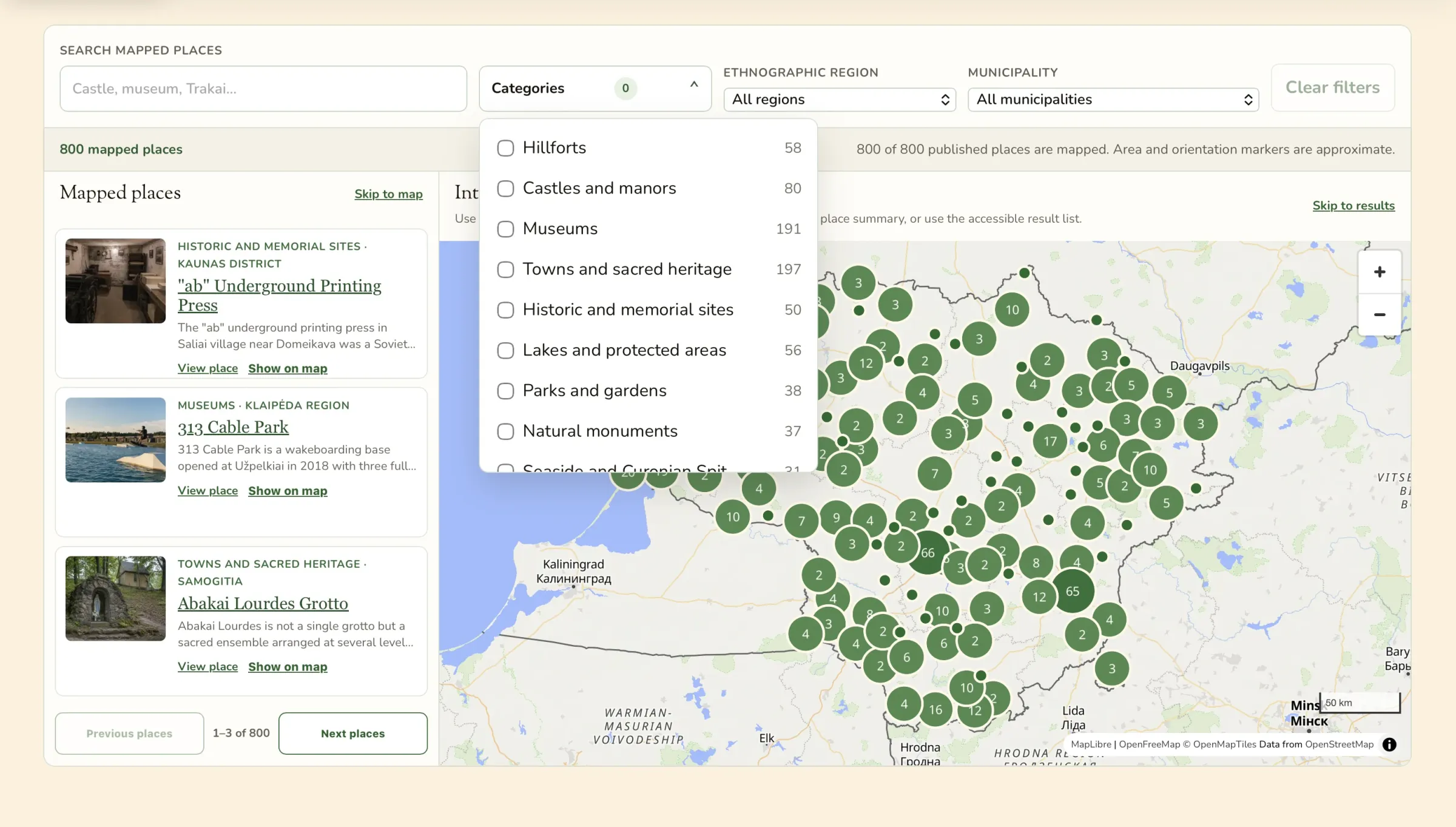
The travel section makes cultural and natural places easier to discover before a trip. Visitors can search by name, filter by category, ethnographic region, or municipality, explore marker clusters, and open the full guide for any result.
Useful filters
Place type, ethnographic region, municipality, and text search.
Transparent location data
Verified pins keep their source and date, while broader-area markers are clearly described as approximate.
Accessible fallback
Every mapped place also appears in a keyboard-friendly text results list.
Trip-ready context
Each marker opens a summary and connects to a researched place guide.
A language gap, addressed
Samogitian is one of Lithuania’s two main dialect groups and remains a living part of western Lithuanian identity. Mainstream translation products rarely treat it as a practical writing language, so Web Aloha built a dedicated tool for it.
The translator works toward a traditional Northern Samogitian spelling profile. It combines reviewed phrases, word senses, grammatical forms, lexical exceptions, and spelling rules. It also runs locally in the visitor’s browser instead of sending text to a third-party translation API.
Samogitian speakers can suggest a more accurate word, phrase, grammatical form, spelling, or regional variant directly from the translation they are viewing. Each contribution, together with useful context such as locality and the speaker’s basis for the suggestion, is saved to a purpose-built feedback database. The Lietuva.love editorial team then reviews it and, when the evidence supports a change, uses it to improve the translator’s rules. This gives the Samogitian community a practical role in helping the tool grow.
Explainable by design
A reviewed language system with defined behavior, not an opaque generic language switch.
Tested for safe behavior
Regression and diagnostic cases cover phonology, grammar, inflection, context, formatting, and abstention.
Community-powered improvement
Samogitian speakers can propose corrections while translating. Suggestions enter a dedicated review database, where the editorial team evaluates them before any translator rule is changed.
Built for long-term trust
Lietuva.love uses Astro, but the framework is not the story. The outcome is: fast pages, clean content, fewer moving parts, and a foundation that can grow without becoming fragile.
Fast by default
Most pages arrive as lightweight HTML, while JavaScript is reserved for features that truly need it, such as the map and translator.
Strong security baseline
A restrictive content policy, HTTPS enforcement, frame protection, and limited browser permissions reduce common attack paths.
Accessible structure
Landmarks, language tags, heading order, image dimensions, labels, skip links, and keyboard-friendly alternatives are checked automatically.
Search-ready foundations
Canonical URLs, hreflang, sitemaps, internal search, metadata, and structured entities make a very large site understandable.
Prepared for AI discovery
Clear entities, cited information, predictable page structure, and schema help AI search systems identify topics, provenance, and relationships.
Protected as it grows
The production build checks content, page sizes, map completeness, translations, SEO titles, FAQs, accessibility, schema, and security.
Measured performance
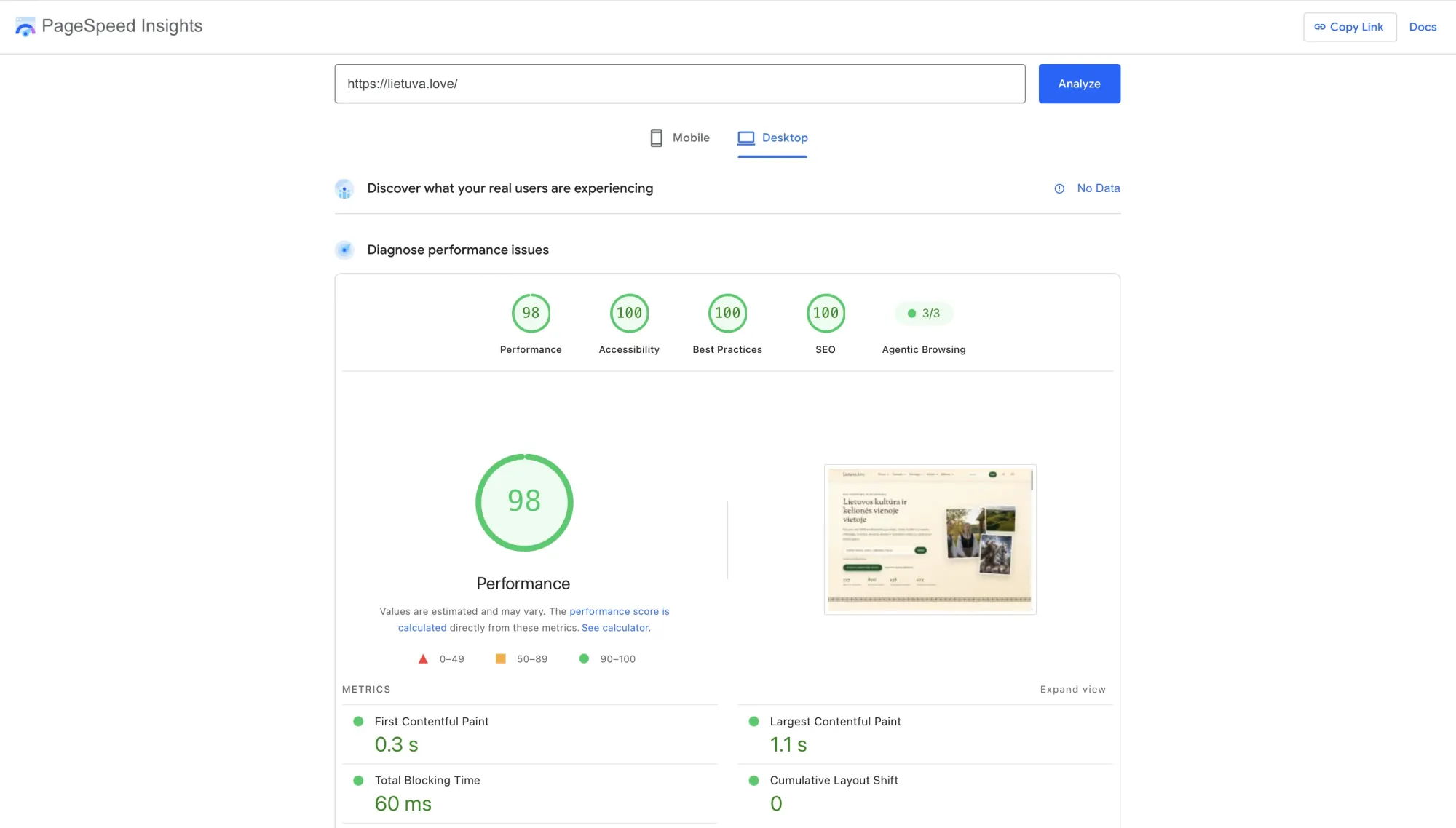
Independent homepage lab tests on July 14, 2026 showed excellent speed and quality scores. They show the strength of the production foundation.
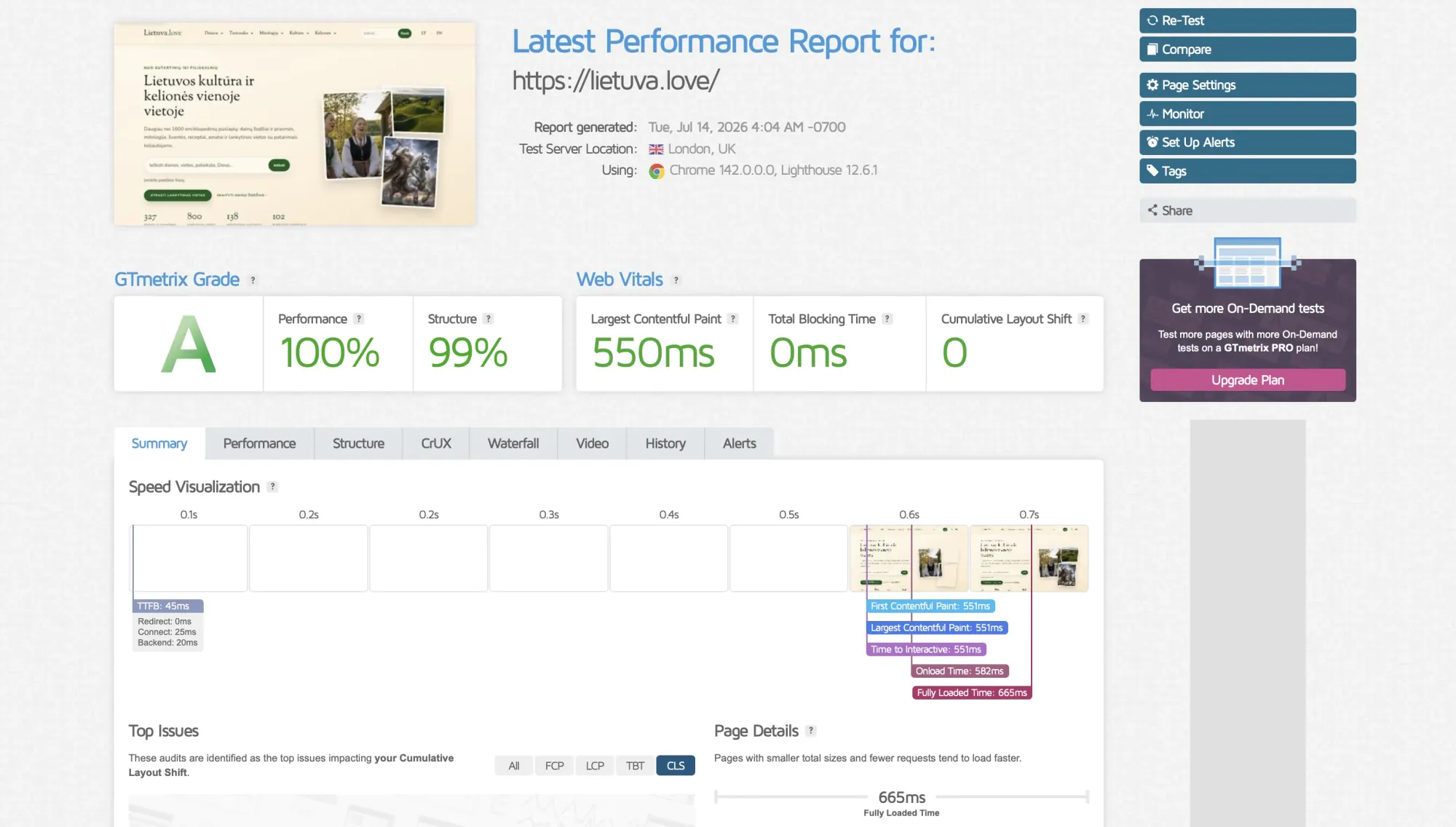
GTmetrix result
PageSpeed desktop audit
Still growing
Lietuva.love is actively maintained and improved by Web Aloha. New guides, English and Russian editions, travel data, translator rules, source updates, and quality checks continue to expand the usefulness of the platform.
The project shows what thoughtful web work can do beyond selling a service: make cultural knowledge easier to find, easier to trust, and easier to carry forward.
Web Aloha designs fast, trustworthy websites and digital platforms that make complex information feel simple. Tell us what you want to build.
Discuss your project 🔥