Full Astro rebuild
Best for marketing sites, content libraries, documentation, and lead-generation sites with structured content and limited private state.
Last updated:
Find out whether your best route is a full Astro rebuild, an Astro front end with retained services or CMS, or improving WordPress first. The assessment evaluates the workflows a public crawl cannot see, then ends with a plain-English scope summary and a starting price.
We build this
This site is built on Astro and optimized for lean delivery. We migrate suitable WordPress sites with redirects, metadata, performance targets, and search visibility monitored throughout the move.
No reloads, no waiting. We migrate suitable WordPress sites to a smaller static attack surface with faster delivery and lower hosting overhead.
A URL scan can inventory public pages, but it cannot answer the questions that determine architecture. This assessment evaluates six connected areas:
The output separates Astro opportunity from dynamic complexity and migration risk. A site can have high opportunity and high complexity simultaneously; that usually points to a hybrid architecture, not a simplistic yes or no.
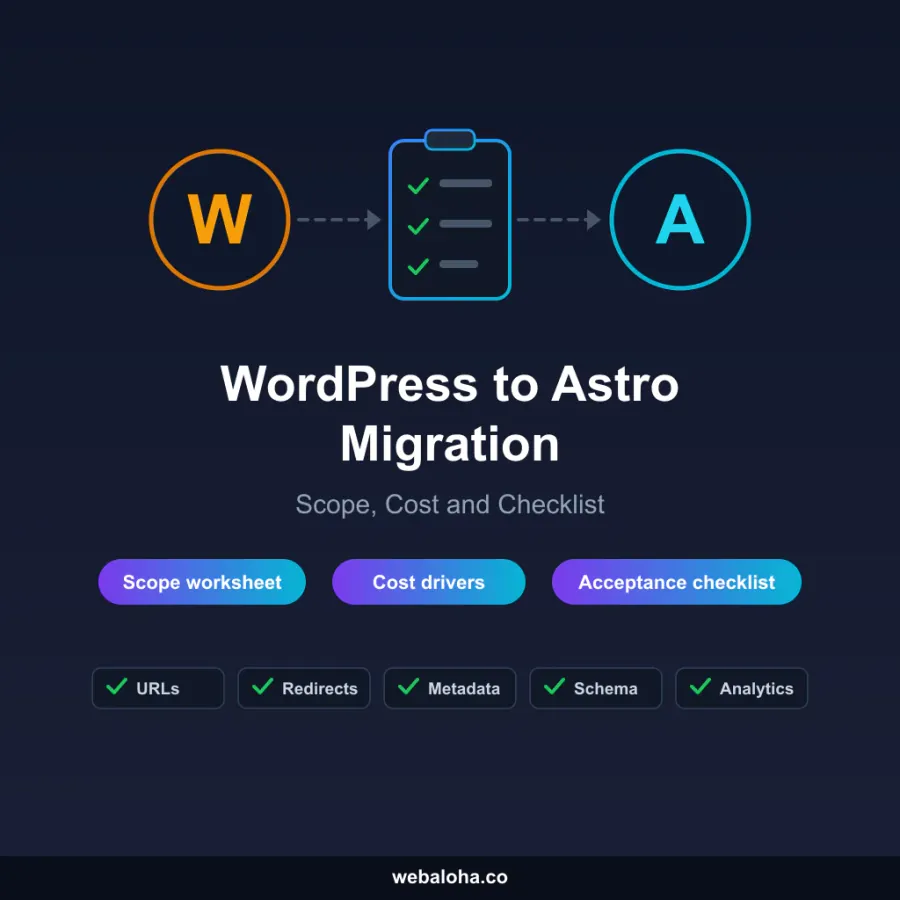
Every report ends with a plain-English scope summary of your answers and the closest starting package from our published migration prices. When a migration is not the right move, it suggests the better next step instead. For a deeper scoping method, read WordPress to Astro migration: scope, cost and checklist.
Astro is optimized for content-driven websites and can ship most pages as HTML while adding JavaScript only where interaction is needed. It can also render on demand. That flexibility does not mean every WordPress capability should be rebuilt inside one Astro project. See Astro’s official explanations of its server-first approach and CMS options.
Best for marketing sites, content libraries, documentation, and lead-generation sites with structured content and limited private state.
Best when editors need a CMS or the site relies on commerce, identity, search, bookings, or other specialist backends.
Best when application-like plugin behavior, page-builder freedom, or missing technical ownership outweighs the measured replatforming benefit.
Keeping WordPress as a headless CMS is a valid hybrid: editors retain a familiar admin while Astro owns presentation through the WordPress REST API or a GraphQL layer. It preserves some WordPress maintenance, so it should be chosen for workflow value rather than presented as “removing WordPress.”
A reliable migration maps capabilities and data, not just rendered HTML.
| WordPress asset | Possible Astro destination | Required validation |
|---|---|---|
| Pages, posts, taxonomies | Content collections, Markdown/MDX, or headless CMS | Counts, fields, dates, authors, relationships, formatting |
| ACF and custom post types | Typed content schema and reusable components | Every field, conditional rule, default, and relationship |
| Elementor or shortcodes | Purpose-built Astro components | Visual parity, responsive states, accessibility, missing embedded data |
| SEO plugin output | Layout metadata, schema components, sitemap and robots routes | Titles, descriptions, canonicals, robots, schema, hreflang |
| Forms and email | Server endpoint, CRM, or form platform | Validation, spam, consent, storage, notification and failure paths |
| WooCommerce | Retained or replacement commerce backend | Catalog, customer, order, payment, tax, shipping, webhook parity |
| Redirect plugin and legacy URLs | Host or edge redirect configuration | One-hop final destinations, query behavior, loops, chains, 404s |
The framework change should be treated as a measured website migration. Before implementation, combine crawls, XML sitemaps, Google Search Console, analytics, backlink data, redirect history, and stakeholder knowledge into one URL inventory.
Use the Redirect Checker, Canonical URL Checker, and Schema Markup Validator as focused QA checks.
Next steps
Continue with the closest follow-up checks and guides based on this tool's topic, crawl intent, and optimization workflow.
Free Website Audit
Not sure what to fix first on your own website? We'll review it and tell you, in plain English, within 48 hours. Free and non-obligatory.
We map content, workflows, integrations, redirects, and SEO signals before recommending a full Astro rebuild, a hybrid design, or no migration at all.