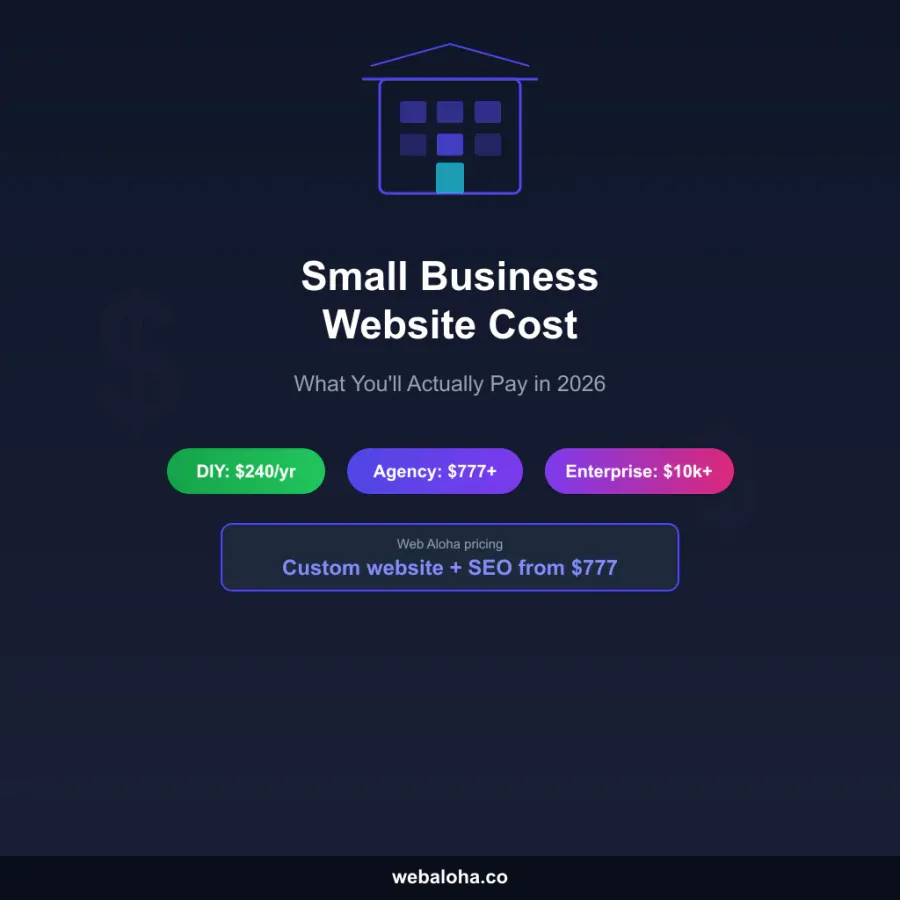
Web Aloha's one-time speed optimization starts at $333 for Essential, $555 for Advanced, and $777 for E-commerce. These are our published starting prices in USD. The final quote depends on the agreed pages, bottlenecks, access, and testing scope.
| Package | Price (USD) | When to consider it |
|---|---|---|
| Essential | From $333 | Brochure sites and blogs needing core fixes to images, script loading, caching, and layout stability. |
| Advanced | From $555 | More complex business sites needing the Essential work plus CDN, server response, plugin, database, or third-party script work. |
| E-commerce | From $777 | WooCommerce and online stores needing the Advanced work plus product images, catalog queries, cart, checkout, and payment scripts. |
Tell us which pages are slow and what visitors need to do on them. We reply within 24 hours and confirm the package and how the result will be measured before any work starts.
The service page lists the full inclusions. These packages cover optimization; a platform rebuild needs its own scope. Ask whether any proposed hosting, CDN, or paid-plugin fees are included, and who owns ongoing monitoring.
A price is meaningful when the scope is clear. A slow brochure homepage, a plugin-heavy business site, and a store with checkout delays require different work. And “optimizing a website” does not always mean speed, so first check which problem you are paying to fix, then use the repair-or-rebuild table to scope it.
For a quick baseline, run the Website Performance Checker. To compare proposals, download the quote-comparison brief and send the same scope to each provider.
Is It Speed, SEO, Conversion, or a Rebuild?
| What you notice | Likely problem | Where to start |
|---|---|---|
| Pages feel slow on phones, PageSpeed Insights or Search Console flags Core Web Vitals, or pages carry heavy images and scripts | Speed | Speed optimization, using the packages above |
| Important pages are missing from Google, rankings have slipped, or the content does not match what people search for | SEO: indexing, content, or links | SEO services |
| Visitors arrive but rarely enquire: the offer is unclear, calls to action are weak, or forms put people off | Conversion | A Website Fix Sprint: one focused week on one bottleneck |
| The theme, builder, or platform keeps causing problems, fixes do not last, or the site no longer fits the business | Rebuild or migration | A website redesign or a WordPress to Astro migration |
Problems often overlap: a slow site can also have an SEO gap, and a fast site can still lose enquiries. Start with the one that costs you the most, and measure it before and after. Not sure which row fits? A Free website audit looks at design, speed, SEO, and AI-search visibility. Audits arrive within 48 hours.
Should You Optimize the Existing Site or Rebuild?
| What you have found | Approach to scope first | What the quote needs to cover |
|---|---|---|
| One identified image, font, or script-loading defect; the rest of the site meets your needs | A targeted repair, such as a Website Fix Sprint | The affected resource and templates, a same-condition comparison, and visual or functional checks |
| Several performance bottlenecks, with a CMS and design you want to keep | A speed optimization package | Representative templates, required integrations, implementation limits, and mobile/desktop journey testing |
| A store slowed by catalog queries, product images, cart, or payment scripts | E-commerce optimization | Product-to-checkout behavior, caching boundaries, payment dependencies, and functional regression checks |
| Recurring constraints in the theme, builder, or architecture, alongside broader content or workflow needs | Compare an optimization quote with a rebuild or migration quote | Content and URL inventory, integration decisions, redirects, staging, cutover, and ongoing editing responsibilities |
A low score alone does not establish that a rebuild is worthwhile. Compare the work needed to keep the current platform with the cost and operational fit of changing it. For the platform tradeoffs, see WordPress versus Astro for business and our WordPress-to-Astro migration scope.
A real example of scope: Gridinta’s migration
Our Gridinta case study publishes before-and-after screenshots with the test method. GTmetrix tested the public homepage from London with Chrome 142 and Lighthouse 12.6.1 on 4 August 2026 (WordPress) and 7 August 2026 (Astro). Reported LCP changed from 2.4 seconds to 477 milliseconds, and page size from 962 KB to 789 KB.
Those are dated lab results for a rebuild, not a promise for a small optimization task. They are not field percentiles, customer-revenue results, or a reason to assign the same budget to every site. The case study does not publish the project fee, so we cannot derive a price-per-second-saved from it.
For image delivery specifically, our 25-project Astro Image vs Picture analysis found that AVIF was larger than WebP in 5.3% of matched generated candidates. File conversion alone is not an acceptance criterion: check the resource the browser actually selects and its visual quality.
How to Compare Prices Across Providers
The package prices above describe Web Aloha’s offer. They do not establish a market average. Other providers may quote different platforms, starting conditions, deliverables, or levels of testing, so an advertised price alone cannot tell you which proposal fits.
Use public prices to build a shortlist, then normalize every quote against the same brief:
| Comparison field | What to record | Why it changes cost |
|---|---|---|
| Baseline | URLs, device profile, lab-tool version, field-data window | A single homepage score is not a site baseline |
| Scope | Templates, checkout, logged-in areas, integrations | More distinct runtime paths require more testing |
| Bottleneck | Images, JavaScript, CSS, server response, database, third parties | Different causes require different specialists and access |
| Environment | CMS, hosting, CDN, staging, deployment process | Some fixes depend on infrastructure or release controls |
| Evidence | Before/after runs, field-data follow-up, change log | A score without a reproducible method is weak proof |
| Risk and QA | Browsers, devices, forms, analytics, payments, rollback | Performance changes can break business-critical behavior |
| Handoff | Documentation, monitoring, warranty, maintenance | Ongoing responsibility is different from a one-time fix |
Record one-time implementation and recurring hosting, CDN, plugin, or maintenance charges separately. Confirm currency, taxes, exclusions, and what happens if the audit uncovers additional work before comparing totals.
What Usually Drives the Price
Number of templates and user journeys
A five-page brochure site may use one or two templates. A store may have category, product, cart, checkout, account, search, and campaign templates plus third-party payment and analytics code. Count distinct behaviors, not just URLs.
Root cause
Image compression is bounded work. Reducing server response time may involve hosting, database queries, caching, application code, or an upstream API. Third-party scripts can require business decisions because removing or delaying them may affect measurement, chat, advertising, consent, or checkout.
Access and release risk
A provider who can change a staging environment and deploy through a tested pipeline can work differently from one making changes directly in production. Backups, review environments, rollback, and regression checks are part of the scope even though they do not appear in a Lighthouse score.
Measurement requirement
Lab tools are useful for repeatable diagnostics. Field data reflects eligible real-user visits over a rolling window and will not update immediately after release. A credible plan states which data answers which question.
Google’s page experience guidance explains that Core Web Vitals are used by its ranking systems but that good scores do not guarantee top rankings. Google’s PageSpeed Insights documentation distinguishes lab diagnostics from available field data.
One-Time Project or Ongoing Work?
Choose a one-time project when the site has a defined backlog and a stable release process. The handoff should include the baseline, changes, QA evidence, remaining constraints, and a way to detect regression.
Choose ongoing monitoring and optimization when templates, inventory, campaigns, dependencies, or third-party scripts change frequently. A retainer should name the monitoring interval, response boundary, included implementation time, and what triggers a new project.
Neither model is automatically cheaper. Compare expected work and ownership over the same period.
How to Build a Defensible Business Case
Do not copy a conversion-lift percentage from another company’s case study. Calculate a range from your own funnel:
affected sessions × current conversion rate × contribution per conversion
= current contribution from the affected journey
Then define the smallest improvement that would repay the project:
project cost ÷ contribution per conversion
= additional conversions needed to break even
Run the same analytics definition before and after release, and annotate promotions, seasonality, traffic-mix changes, tracking changes, and other releases. A performance improvement and a revenue change occurring together do not by themselves prove causation.
Download the Quote-Comparison Brief
Download the website speed quote-comparison brief (plain text). No form is required. Open it in any text editor to fill it in or print it.
The brief has a shared site and measurement section, a repeatable provider-response section, and an approval checklist. It captures one-time and recurring charges, included templates, exclusions, QA, rollback, and handoff ownership. It contains no assumed project fee or promised score.
- Describe the same problem for every provider. List representative URLs, the visitor journey affected, the platform, and any features that must keep working.
- Attach a reproducible baseline. Include the test date, device and network settings, saved reports, and available field-data scope.
- Ask each provider to complete the same response. Resolve blank or vague inclusions before deciding on price. For a rebuild, include redirects, integrations, editing needs, and cutover responsibilities.
Be cautious with guaranteed PageSpeed scores or ranking promises. Scores vary with test conditions, and providers do not control Google’s ranking systems, the visitor’s device, the network, or every third-party dependency.
To scope work with Web Aloha, send your URL and the affected journey. We will confirm the suitable package, measurement scope, and constraints before work starts. You can review the full speed package inclusions alongside your completed brief.
Frequently asked questions
How much does website speed optimization cost?
Web Aloha offers Essential, Advanced, and E-commerce one-time speed optimization packages with published starting prices shown in this guide. Your final quote depends on the pages, bottlenecks, access, and testing scope. Compare the same deliverables across providers; package prices are not a market average.
Is website speed optimization a one-time cost or ongoing?
It can be either. A one-time project addresses agreed current issues. New content, plugins, and third-party scripts can introduce regressions, so ongoing monitoring may be useful when the site changes frequently. Confirm who monitors performance and which follow-up work is included.
Can I optimize my website speed myself for free?
Partially. Free tools like Google PageSpeed Insights, GTmetrix, and Lighthouse identify problems. Some fixes are simple: compressing images, enabling browser caching, removing unused plugins. But deeper issues like server configuration, code optimization, CDN setup, and Core Web Vitals tuning usually require professional help to fix properly.
What is the ROI of website speed optimization?
Calculate ROI from your own funnel: affected sessions multiplied by current conversion rate and contribution margin, then compare that baseline with a controlled post-change period. Published case studies can explain why speed matters, but they cannot predict your conversion lift or payback period.
Why do some agencies charge thousands for speed optimization?
Higher quotes may include more templates, third-party integrations, backend work, monitoring, regression testing, documentation, or service-level commitments. Compare deliverables and exclusions rather than inferring value from provider size or price alone.
What should I look for when hiring someone for speed optimization?
Look for transparent pricing, a clear list of deliverables, before and after reporting, and experience with your specific platform (WordPress, WooCommerce, Astro, etc.). Avoid providers who can't explain what they'll do, don't share results, or lock you into long-term contracts for a one-time fix.
Does faster website speed actually improve Google rankings?
Google says Core Web Vitals are used by its ranking systems, but good scores do not guarantee top rankings and relevance remains more important. Performance work should also be evaluated through user experience and business outcomes, not ranking claims alone.
What if my website problem is SEO or conversions rather than speed?
Then a speed package is the wrong purchase. Speed work fixes slow pages, heavy resources, and Core Web Vitals. If important pages are not indexed or ranking, start with SEO. If visitors arrive but rarely enquire, start with conversion fixes such as a Website Fix Sprint. If the theme or platform keeps limiting you, compare a redesign or migration quote.
How long does professional speed optimization take?
The schedule depends on scope, access, platform, third-party scripts, hosting changes, and the number of templates that require regression testing. Ask for a written plan with measurement, implementation, QA, and handoff milestones rather than relying on a universal duration.