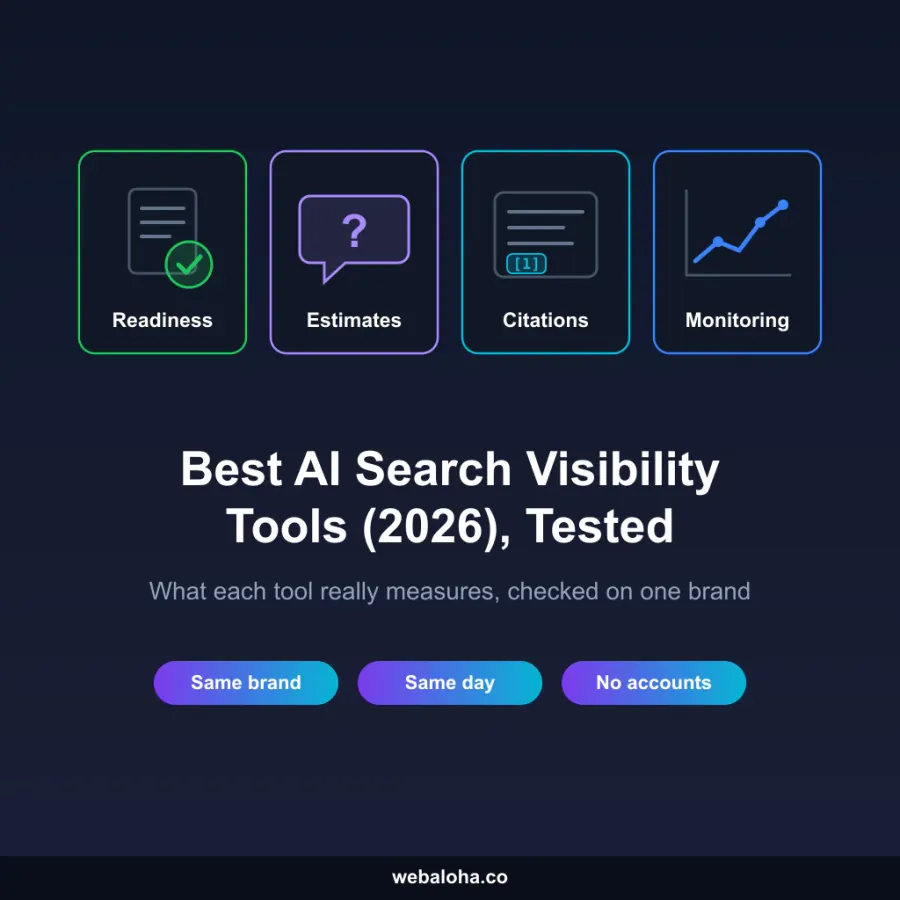
AI visibility is not one metric. A platform may mention your brand without linking, cite a page without sending a click, or send a small number of visits that convert unusually well. Combining all of those into one number hides more than it reveals.
A useful GEO measurement system keeps four outcomes separate:
- appearances in platform-provided reports;
- citations or mentions observed in a repeatable prompt sample;
- referral sessions from AI platforms;
- business outcomes from those sessions.
What each source can prove
| Source | What it measures | What it cannot prove |
|---|---|---|
| Search Console generative AI performance reports | Impressions in AI Overviews and AI Mode, and in Discover’s generative AI features, with the pages, countries, dates, and (for Search) devices involved | Clicks, CTR, position, or the queries behind those impressions; visibility in ChatGPT, Perplexity, or other platforms |
| Standard Search Console Performance report | Overall Google Search clicks, impressions, queries, and pages; Google says AI Overviews and AI Mode activity is included in the Web search type | Which of those clicks, queries, or impressions came from AI features, because the report has no AI-feature filter |
| Web analytics | Visits and conversions where a referrer or campaign parameter is preserved | Mentions and citations that produced no click |
| Manual prompt panel | What selected prompts returned under recorded conditions | Population-wide share of voice or a stable ranking |
| Third-party monitoring tool | The vendor’s sampled prompts, locations, accounts, and matching logic | Complete platform coverage unless the methodology demonstrates it |
The table is the core discipline: label every chart with the evidence it actually contains.
Google Search Console in 2026
Google announced its Search generative AI performance reports on 3 June 2026 and first rolled them out to a subset of sites. A note on that announcement, repeated on the Search Console Help page, says that as of 31 August 2026 the reports have rolled out to all websites worldwide.
There are two reports: one for Search, covering AI Overviews and AI Mode, and one for generative AI features in Discover. They show:
- impressions, meaning how many times links to your site were shown in a generative AI feature;
- the pages shown;
- countries;
- dates, so you can follow the trend over time;
- devices (Search report only).
They do not show clicks, CTR, average position, or the queries that triggered the feature, and Google excludes Search Labs experiments. Google’s Search Analytics API reference lists no generative AI search type, so as of September 2026 the data comes from the Search Console interface and its export button rather than the API.
Google’s AI features guide also says activity from AI Overviews and AI Mode stays included in the overall Performance report under the Web search type. A click on a link in an AI Overview or AI Mode counts as a click there, and every link in an AI Overview shares the overview’s single position, but that report has no filter that separates AI-feature traffic. Therefore:
- use the generative AI report for Google-specific AI visibility trends;
- if the report does not appear for your property, record that rather than estimating: Google’s Help page lists the gradual rollout, too few impressions in these features, or the site being excluded from them as possible reasons;
- do not describe ordinary Web impressions or clicks as AI Overview impressions or clicks;
- preserve screenshots or exports with the report name, property, filters, and date range.
An impression is not necessarily a visit, and a visit is not necessarily a lead. Pair the report with analytics and conversion data.
Track AI referral traffic
Create an analytics segment that captures known AI referrers and campaign sources. OpenAI’s publisher FAQ says ChatGPT search referral URLs include utm_source=chatgpt.com, so track that value explicitly as well as the chatgpt.com referrer.
For every source, monitor:
- sessions and engaged sessions;
- landing page;
- enquiry, signup, purchase, or other meaningful conversion;
- revenue where it can be attributed responsibly;
- changes in referrer or campaign naming over time.
Referrer data is incomplete by nature. Apps, privacy controls, redirects, and browser behavior can remove or rewrite attribution. Report AI referral traffic as a measured lower bound, not a full count of AI-influenced visits.
Build a repeatable prompt panel
Platform reports do not cover every system, so a controlled prompt sample is useful. It becomes evidence only when the method is recorded.
Create a sheet with these columns:
| Field | Example |
|---|---|
| Query ID | local-service-01 |
| Exact prompt | Best way to evaluate a web design agency |
| Intent | Commercial research |
| Platform and mode | Perplexity web search |
| Account state | Signed out |
| Location/language | US / English |
| Run date | 2026-08-20 |
| Brand mentioned | Yes/No |
| Linked citation | URL or blank |
| Position in source list | Number or blank |
| Screenshot/evidence | Stored reference |
Use a fixed set of representative prompts. Run them on a consistent schedule. Do not silently replace weak prompts with easier ones, and do not count your own domain when it appears only because the prompt names the brand.
Because generated answers can vary between runs, report a range or repeated-sample rate when practical. A single favorable screenshot is an example, not a trend.
Keep the metrics separate
A compact monthly dashboard can contain:
- Google generative AI impressions (Search, plus Discover where it matters);
- linked-citation rate across the fixed prompt panel;
- unlinked brand-mention rate;
- AI-referred sessions;
- AI-referred conversions and conversion rate;
- top cited and top converting landing pages;
- implementation notes for material content or technical changes.
If you create a composite “AI visibility score,” publish the formula and keep every component visible. The score is useful for internal trend comparison only; it is not an industry-standard market share figure.
Avoid common measurement errors
- Do not treat an AI-readiness audit as citation tracking. A crawler-access or schema check shows implementation conditions, not whether platforms cite the site.
- Do not attribute every Google impression to AI. Use the generative AI report for AI-feature impressions, and remember that it has no click or query data.
- Do not mix prompts, locations, and account states without labels. Personalization and availability can change outputs.
- Do not promise a fixed time to results. No official platform publishes a universal GEO timeline.
- Do not confuse training controls with search visibility. For OpenAI,
GPTBotandOAI-SearchBotserve different documented purposes. - Do not report a mention as a referral. Visibility, traffic, and conversion are separate stages.
A practical baseline
Start with the data you can defend today:
- export the Search Console generative AI performance report (Search, plus Discover where relevant), or record why it is not available for the property;
- create an AI-referral segment in analytics;
- define a small, fixed prompt panel around real customer questions;
- record the site, content, and crawler configuration at baseline;
- note substantive changes and compare the same measures over time.
Our AI Search Visibility Checker is a technical readiness screen; it can help identify crawl access, schema, and page-structure issues, but it is not evidence that a platform currently cites the site. For implementation priorities, use the complete GEO guide. If you need a managed measurement program, see the scope and limits of our GEO services.
Frequently asked questions
What is AI search visibility?
AI search visibility describes how often a brand, page, or source appears in generated search experiences. Measure linked citations, unlinked mentions, referral visits, and conversions separately because they represent different outcomes.
Can Google Search Console measure AI Overviews and AI Mode?
Partly. Search Console's generative AI performance report shows how often links to your site appeared in AI Overviews and AI Mode, by page, country, device, and date. It counts impressions only: no clicks, CTR, position, or queries. Google launched it for a subset of sites on 3 June 2026 and says it reached all websites worldwide on 31 August 2026. Clicks from these features stay inside the overall Performance report under the Web search type.
How can I track traffic from ChatGPT?
OpenAI says ChatGPT search referral URLs include utm_source=chatgpt.com. Track that campaign source and the chatgpt.com referrer in analytics, then connect sessions to meaningful conversions.
Can one visibility score compare every AI platform?
Only as an internal trend metric. Platforms expose different data and change their answers by query, location, account, and time. Keep the underlying counts visible rather than presenting one score as a universal market share measure.
How long does GEO take to work?
There is no platform-backed universal timeline. Establish a baseline, record implementation dates, and compare like-for-like query samples and conversion data over multiple measurement periods.