Generative Engine Optimization (GEO): Complete 2026 Guide

Author: Lucky Oleg | Published
Generative Engine Optimization (GEO): Complete 2026 Guide

Generative Engine Optimization (GEO) is the practice of making your website easier for AI search engines to retrieve, trust, and cite inside their generated answers. It is not replacing SEO. It is a new layer on top of it. If traditional SEO gets you ranked in a list of links, GEO gets you quoted inside the answer itself.

The term was formalized in a 2024 research paper from Princeton, Georgia Tech, the Allen Institute for AI, and IIT Delhi. The researchers tested nine specific content optimization techniques across 10,000 queries and found that targeted changes, such as adding statistics, citing authoritative sources, and improving content structure, could improve AI visibility by up to 40%. They also found that keyword stuffing, the oldest trick in SEO, actively made things worse.

This article is an ultimate guide about Generative Engine Optimization. It covers everything: how AI search engines pick sources, what to do on-page and off-page, how to measure results, and a general implementation roadmap.

Every recommendation is backed by academic research, or industry data and our findings from professional GEO services that Web Aloha team provides.

What Is Generative Engine Optimization (GEO)?

GEO is the practice of optimizing your content so it gets retrieved, verified, and cited inside AI-generated answers, not just ranked in a traditional list of blue links.

When someone asks ChatGPT, Google AI Overviews, or Perplexity a question, these systems do not just look up a webpage and show it. They search the web, pull relevant passages from multiple sources, run verification checks, and then generate an answer with citations. GEO is about making sure your content survives that pipeline and gets cited at the end.

The concept comes from a landmark study published at ACM SIGKDD 2024 by researchers from Princeton University, Georgia Institute of Technology, the Allen Institute for AI, and IIT Delhi. The study tested nine distinct optimization strategies and measured their impact on whether content got cited in AI-generated responses.

The results were clear. Adding relevant statistics to content improved visibility by up to 41%. Adding authoritative citations boosted visibility by 115.1% for sites that were not already ranking in the top positions, meaning GEO can help smaller sites compete more effectively. Meanwhile, top-ranked websites that relied solely on traditional SEO tactics saw their AI visibility drop by 30.3%.

The most important finding: keyword stuffing, still one of the most common SEO tactics, performed poorly across every test. It sometimes made visibility worse than doing nothing at all.

GEO is not a replacement for SEO. Google documentation states that AI features use the same baseline eligibility as traditional Search. You still need crawlability, indexability, quality content, and technical health. If you are still wondering whether your business even needs a website, the answer is yes, and here is why. GEO adds a new optimization layer focused on making that content easy for AI systems to extract, verify, and attribute.

Why GEO Matters in 2026

The scale of AI search in 2026

The shift from search results to AI-generated answers happened faster than most people expected.

Google rolled out AI Overviews broadly in the U.S. in May 2024, expanded them to more than 100 countries in October 2024, and later said the feature had grown to 2 billion users every month. Google also says AI features may use query fan-out and surface a wider and more diverse set of helpful links than classic web search.

OpenAI says more than half a billion people actively use its AI tools and send more than 2.5 billion messages per day. In February 2026, Microsoft introduced AI Performance in Bing Webmaster Tools so publishers can see citation counts, grounding queries, and URL-level citation activity.

Clicks are declining, but AI traffic is easier to track

Google says clicks from pages with AI Overviews are often higher quality, while OpenAI says ChatGPT automatically appends utm_source=chatgpt.com to referral URLs, making ChatGPT search traffic easier to track in analytics.

This changes the practical question. It is no longer only about maintaining the same traffic volume. It is also about becoming one of the sources that gets cited, so the visits you do earn come from users who have already seen your brand inside the answer.

Google says pages shown in AI Overviews and AI Mode use the same baseline eligibility as Google Search. In practice, that means AI visibility is not some detached parallel universe. It is increasingly fused into normal search behavior. Google also points that clicks coming from AI features tend to be higher quality, with users more likely to spend more time on site.

At the same time, the old assumption that ranking alone guarantees visibility is cracking. Ahrefs’ 2026 analysis found that only about 38% of URLs cited in AI Overviews also ranked in Google’s top 10 organic results for the same query. That is a big shift. Page-one presence still helps, but it is no longer the whole orchestra. And that’s where GEO comes to play.

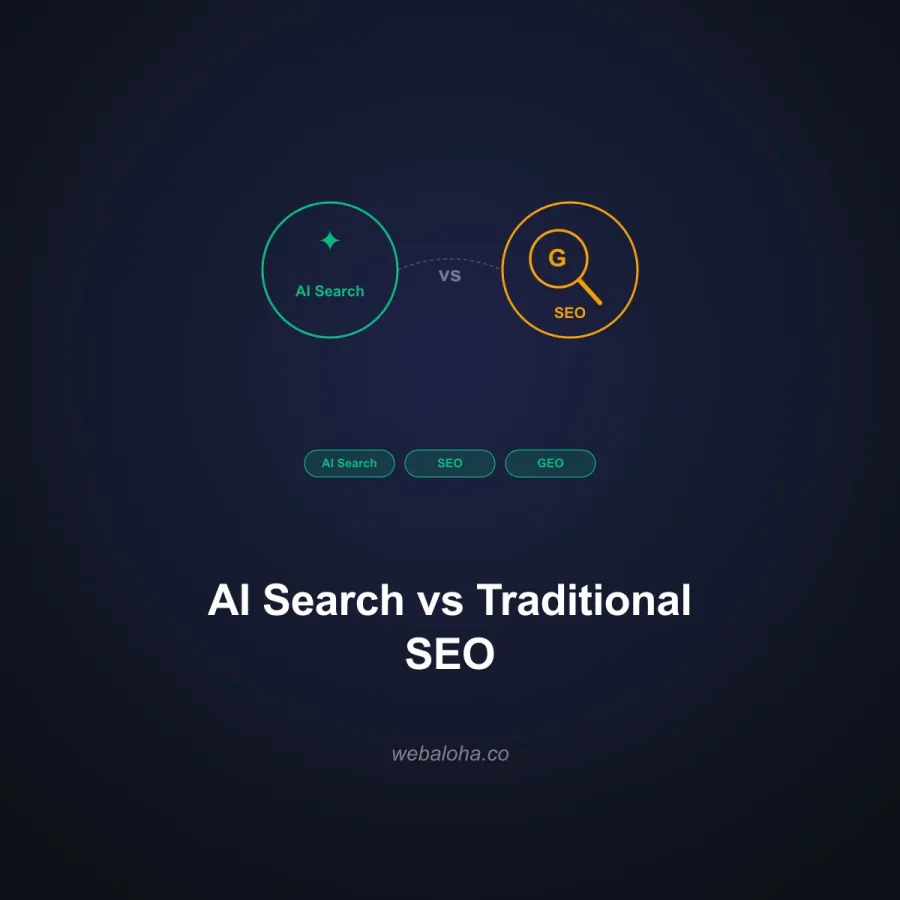
GEO vs SEO: What’s Different

What changed in GEO vs SEO

The fundamental unit of optimization shifted. In SEO, you optimize a page to rank for a query. In GEO, you optimize individual passages to be retrieved and cited as part of a synthesized answer.

AI engines break your content into passages and evaluate whether specific claims and sections are useful enough to cite. Google says AI features may use query fan-out, which means your content competes not just on the head query but on the related questions the system generates behind the scenes.

The biggest off-page shift comes from the Ahrefs study: brand mentions correlate much more strongly with AI visibility than backlinks do, with a Spearman correlation of 0.664 for web mentions versus 0.218 for backlinks. AI models learn from text, not just hyperlink graphs.

What stayed the same in both

The foundation has not changed. Google pointed there are no special technical requirements for AI features beyond being eligible for Search. Crawlability, indexability, canonical signals, page experience, and quality content are still essential.

E-E-A-T still matters. Content without clear authorship, expertise markers, or source citations is harder for both people and machines to trust. GEO does not change what good content is. It changes how that content needs to be structured and supported so AI systems can use it.

DimensionSEOGEO
Primary objectiveRank in results list, earn clicksGet retrieved and cited inside generated answers
Unit of optimizationPage + queryPassage + entity + citation-worthy claim
Key off-page signalBacklinksBrand mentions, credibility
Primary KPIRankings, organic trafficAI citations, presence in AI answers
Content format priorityKeyword-targeted long-formAnswer-atomic blocks with evidence
Update frequency importanceModerateHigher, especially for fast-moving topics

How AI Search Engines Pick Sources

The shared AI search pipeline

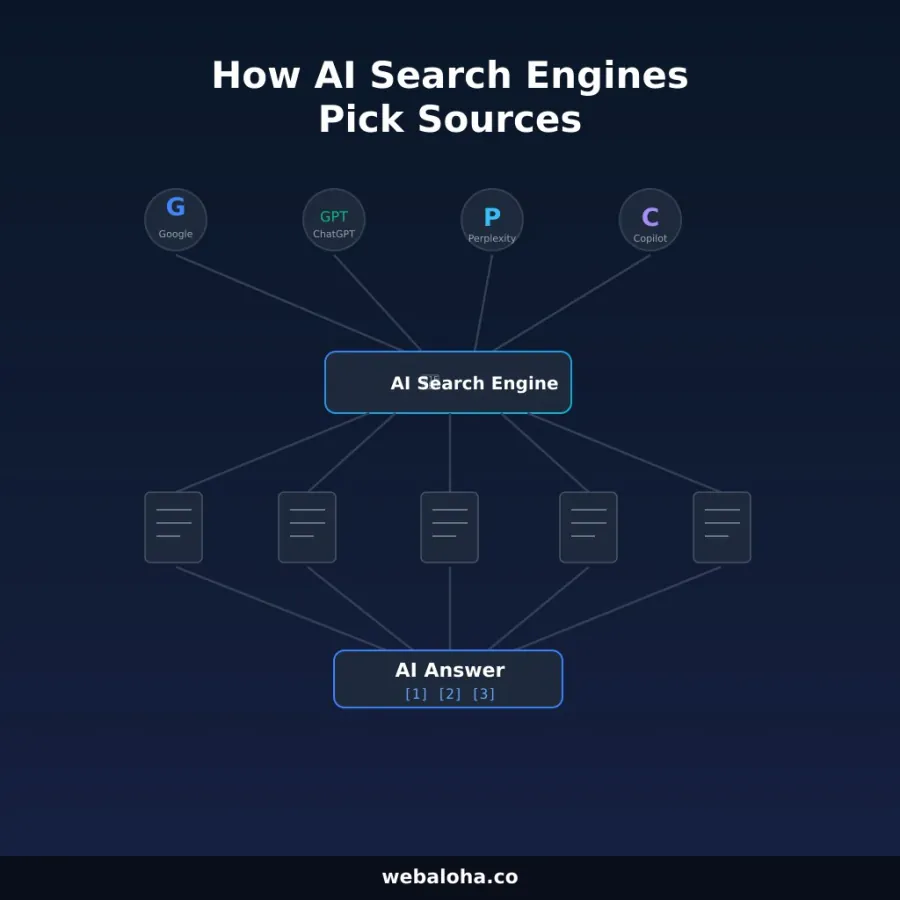
Every major AI search platform follows the same basic pattern, known as retrieval-augmented generation: the system rewrites or expands the user’s query, retrieves relevant documents or passages from the web, runs verification checks, and generates a response with citations.

Two mechanics matter most for GEO. First, Google explicitly documents query fan-out, where the system issues multiple related searches across subtopics and data sources before composing an answer. Second, the public Microsoft guidance for Copilot Studio describes grounding checks, provenance checks, and semantic similarity cross-checks before summarization.

This is why pages built from self-contained answer blocks are easier to reuse than long, meandering prose that only makes sense when read straight through from top to bottom.

Google AI Overviews

Google’s AI Overviews combine Gemini models with core Search systems. According to Google documentation, there are no additional technical requirements beyond being indexed and eligible to appear in Search with a snippet. Google also says AI features may surface a wider and more diverse set of helpful links than classic web search, which helps explain why being position one is no longer the whole story.

Google also documents Google-Extended as a separate control for AI training and grounding that does not affect Search ranking.

OpenAI’s crawler docs make the architecture point that matters most to publishers: OAI-SearchBot controls search inclusion, GPTBot controls training, and ChatGPT-User handles user-triggered actions and is not used to determine whether content may appear in Search. These are distinct bots with distinct functions.

That means search visibility in ChatGPT depends on allowing the right search bot, not just leaving training access open by default.

Perplexity AI

Perplexity publicly documents PerplexityBot as the crawler used to surface and link websites in search results, and it recommends allowing the bot in robots.txt and permitting requests from its published IP ranges.

Perplexity’s crawler documentation is a useful reminder that discoverability and crawl access are practical GEO issues, not abstract theory.

Microsoft Copilot

Microsoft’s public guidance explains that Copilot Studio can retrieve search results, run grounding checks, perform provenance checks, and then summarize them for the user. In February 2026, Microsoft added AI Performance reporting in Bing Webmaster Tools, giving publishers direct visibility into citations and grounding queries.

Why this AI search fragmentation matters

The big lesson is that no single AI surface defines GEO. Each platform has different crawler rules, different retrieval behavior, and different ways of surfacing sources.

A page that performs well across Google AI Overviews, ChatGPT Search, Perplexity, and Copilot usually has a common set of strengths: it is crawlable, explicit, source-backed, and supported by broader trust signals.

But the differences still matter. Each platform has its own crawlers, verification logic, and citation style, and those differences shape what gets surfaced and what gets ignored. We break down exactly how each AI search engine picks and cites sources in a separate article.

On-Page GEO Techniques

On-page GEO starts with your website. Before AI systems can cite your business, they need to access your pages, understand what you offer, and connect your content to the questions real users are asking. That means your site should be crawlable and structured in a way that makes your expertise easy to cite.

In practice, on-page GEO is the bridge between your business and the AI-generated answers your potential customers see. It helps AI systems understand who you are, what you do, who you serve, and which pages are worth surfacing as trustworthy sources.

Let’s break down the most important on-page GEO techniques.

Clear the technical gates for AI first

Before any content optimization matters, your pages need to be accessible to AI systems.

Crawlability and indexing. Ensure important pages are crawlable, have indexable content in supported formats, and comply with spam policies. Use canonical tags to consolidate duplicate content, our canonical URL checker can help you spot issues. Fix internal linking so key pages are strongly signaled and reachable, run an internal link analysis to find orphan pages and weak connections.

AI crawler access. Check that OAI-SearchBot, PerplexityBot, and Google-Extended are not blocked in your robots.txt or by your WAF. This is a surprisingly common blind spot. Aggressive bot protection can block the exact agents that generate citations.

Snippet controls. Google documents nosnippet, max-snippet, and data-nosnippet as controls that can limit how your content is previewed in Search. If you restrict previews too aggressively, you can also restrict what AI features are able to quote and summarize.

Page experience. Google’s AI features guidance still points back to the same SEO fundamentals: allow crawling, make important content available in textual form, support that text with useful media where relevant, and keep your pages easy to navigate and understand. Technical foundations like running the recommended PHP version and keeping your server stack current also contribute to faster response times that AI crawlers appreciate.

Structure content for AI citations

Answer-atomic sections. Every H2 or H3 section should function as a self-contained, extractable answer block. Open each section with a direct answer, then explain why it matters, then support it with evidence.

Question-based headings. Use headings that map to likely sub-queries instead of vague labels. If the heading asks a question, the first lines under it should answer that question directly.

Short paragraphs. Dense walls of text are hard for humans to scan and hard for AI systems to extract from cleanly. Shorter paragraphs and cleaner sentence structure make reuse easier.

Semantic HTML. Use real HTML tables for comparisons, real lists for sequences, and keep important information out of images or client-side widgets whenever possible.

Clever evidence density

This is the highest-leverage on-page optimization for GEO. The Georgia Tech study showed that adding statistics and citations materially improved visibility in generative-engine outputs.

Relevant statistics. Use relevant, attributable numbers where they genuinely help the reader understand the topic. Date them when timing matters.

Inline citations. Link to primary sources such as official documentation, peer-reviewed papers, standards bodies, and original datasets. That gives both humans and machines a clearer provenance trail.

Content formats that get cited by AI

Comparison tables, concise definitions, FAQs, step-by-step frameworks, and strong summary blocks all make content easier to retrieve and quote.

Longer resources can also help when they cover a topic clearly enough to answer multiple related sub-queries on one page. The goal is not to be long for its own sake. The goal is to be useful in several retrieval contexts.

Multimodal support matters too. Google’s AI features guidance explicitly recommends supporting important textual content with high-quality images and videos when relevant.

Schema markup is essential for GEO

Schema markup in JSON-LD format serves as a machine-readable layer that helps resolve entity ambiguity.

Google’s Organization markup documentation says it can help Google better understand your organization and disambiguate it in search results. The structured data intro also notes that Google generally recommends JSON-LD because it is usually the easiest format to implement and maintain.

Organization with sameAs properties on your home or about page, Article on editorial content, BreadcrumbList for hierarchy, FAQPage where you genuinely have question-and-answer content, and Dataset markup when you publish original data all fit naturally into a GEO-friendly setup.

Schema must represent visible, truthful content. It is a clarification layer, not a permission slip for invention. You can check whether your existing schema is valid with our schema markup validator, or generate new markup with our schema markup generator.

E-E-A-T as an AI filtering mechanism

Clear authorship, visible credentials, transparent editorial policies, and obvious evidence of expertise all make content easier to trust.

Implementation is straightforward: named author bylines, dedicated author pages where relevant, visible update history, and a writing style that makes claims supportable instead of vague.

Content freshness matters for AI

Keep important pages current when the topic changes. Refresh statistics, update product or platform references, and make sure your examples still match how the underlying systems actually work.

Microsoft’s AI Performance announcement explicitly recommends keeping content fresh and accurate so AI systems can reference the most current version of a page.

Off-Page GEO Techniques

Off-page GEO starts outside your website. AI systems need signals that confirm your business is relevant, trustworthy, and worth citing. In other words, GEO is not only about what your website says about you, but also what the broader web says about your brand.

If on-page GEO is the bridge between your business and AI-generated answers, off-page GEO helps prove that the bridge is stable, credible, and leads somewhere worth trusting. It gives AI systems more confidence that your business deserves visibility.

What do strong off-page GEO signals actually look like:

This is the most significant paradigm shift from traditional SEO to GEO. The Ahrefs study found that brand web mentions correlate much more strongly with AI Overview visibility than backlinks do: 0.664 versus 0.218.

The same study found that brands earning the most web mentions captured up to 10X more brand mentions in AI Overviews than the next closest quartile. That does not make backlinks irrelevant. It shows that AI systems learn from broad textual presence, not just from link graphs.

The practical shift is from pure link building to mention building: earning relevant, contextual references to your brand in places AI systems already treat as useful evidence.

Entity authority: Knowledge Graph, Wikidata, and brand consistency

AI engines treat brands as entities with attributes, relationships, and verifiable facts. The more consistently your brand is described across your site and third-party profiles, the easier it is for systems to resolve and trust it.

Consistent naming matters more than it seems. Use one canonical brand name everywhere. Then connect your official profiles with Organization markup and sameAs properties so search systems have a cleaner entity map to follow.

Platform presence: where AI engines pull answers from

Community platforms, video platforms, editorial sites, and review pages all contribute to the evidence layer AI systems draw from. If your brand never appears outside its own website, it is harder for AI systems to treat it as broadly validated.

The exact mix differs by platform, which is why off-site presence should be built deliberately rather than left to chance.

AI search seems to favour Reddit, LinkedIn, Youtube.

Digital PR as the primary off-page GEO lever

Original research, useful data points, expert commentary, and credible editorial coverage all create the kind of signals that generative systems can cite or learn from later.

Digital PR matters here because it helps turn your brand into a repeated reference point instead of a self-assertion living only on your own domain.

Even a small original research is great. For example, Web Aloha tested WordPress compatibility with PHP 8.5 on 50+ real websites, and we also published a deep dive into Elementor and PHP compatibility based on real client sites. We’ve published these results and included our techniques, screenshots and proof. AI agents noticed our proficieny in WordPress and started citing us

Example of GEO results: Google AI Overview cited Web Aloha Example of GEO results: Google AI Overview cited Web Aloha

AI crawler access: the invisible blocker

OpenAI operates OAI-SearchBot for search, GPTBot for training, and ChatGPT-User for user-triggered visits. Perplexity documents PerplexityBot for search indexing. Google documents Google-Extended as a separate control for AI training and grounding.

That means WAF rules, bot filters, and robots.txt decisions can silently block the very agents responsible for citation visibility. GEO now includes operational bot management, not just content work.

GEO Readiness Check

Is Your Website GEO-Ready?

Check the items that apply to your site. If you are not sure about most of these and your website is more than a year old, there is a good chance it is not optimized for AI search.

GEO Implementation Roadmap

Phase 1: GEO Audit & foundation

Start by establishing your baseline. Query ChatGPT, Perplexity, Google, and Bing with the prompts your content should answer. Document where you appear, where competitors appear, and where no one from your site is visible at all.

Then clear the technical gates. Verify crawler access, check that important content is available in text, audit schema coverage, and review internal linking so your priority pages are easy to discover and understand. Our AI search visibility checker can show you how AI systems currently see your site.

Phase 2: Content restructuring for GEO

Prioritize the pages that matter most commercially. Add stronger answer blocks near the top, convert vague headings into explicit topical or question-based headings, and improve your evidence density with cited facts and current sources.

Add comparison tables where they help, build FAQ sections where they are genuinely useful, and strengthen authorship and entity clarity across the page.

Phase 3: Authority building for GEO

Move outward from the page itself. Earn mentions, improve profile consistency across the web, build review and editorial presence where relevant, and publish original research or proprietary insights that other sites can cite.

Ongoing Monthly GEO optimization

Run recurring citation checks, refresh pages that are losing relevance, update your source support when the underlying facts change, and feed those observations back into your content plan. This is exactly the kind of continuous work that Web Aloha’s GEO services handle for businesses that want results without managing the moving parts themselves.

Common GEO Mistakes to Avoid

Keyword stuffing. The KDD research has tested this directly and found that it performed poorly for GEO.

Burying answers in long introductions. If the actual answer appears too late, AI systems may never surface it cleanly.

Blocking AI crawlers accidentally. Robots.txt, WAF rules, and anti-bot tooling can prevent citation-generating agents from reaching your content. Feel free to use a simple robots.txt online checker made by Web Aloha.

Relying on JavaScript-rendered content. Especially for essential information. Google’s AI features guidance still recommends keeping important content available in textual form. Do not rely on JS-rendered content too much, since it might be inaccessible for AI systems.

Treating GEO as separate from SEO. GEO sits on top of search fundamentals. If the page is not crawlable, indexable, and well-structured, there is nothing for GEO to amplify.

Aggressive snippet restrictions. If you prevent search systems from previewing your page, you can also limit what AI features are able to quote or summarize. Make sure your website does not have such restrictions.

Summary: GEO Is the Future of Brand Visibility

Generative Engine Optimization (GEO) helps businesses improve visibility in AI search. In 2026, GEO matters because AI systems increasingly shape how people discover brands and services. Businesses that want to be cited in AI-generated answers should take GEO seriously.

Need help improving your business visibility in AI search and AI citations? Explore Web Aloha’s GEO Services.

Go deeper into the GEO cluster:

Useful info? Spread the Aloha:

Lucky Oleg

Lucky Oleg is the founder of Web Aloha, a web design & SEO agency helping businesses ride the digital wave. With years of experience in WordPress, technical SEO, and web performance, he writes about what actually works in the real world.