When most people think about improving their website’s visibility, they think about on-page factors: content quality, schema markup, page speed, keyword usage.

For Generative Engine Optimization (GEO), reviewing external descriptions is useful because customers and retrieval systems can encounter facts away from your own site. Treat citation gains as an outcome to measure.
This guide explains why, and what to do about it.
What Is an Entity in Search?
In the context of search and AI, an entity is a clearly defined, real-world thing: a business, person, product, place, concept.
When Google, ChatGPT, or Perplexity encounters your brand name, they look for signals that help them understand what that entity is:
- What does this business do?
- Where is it located?
- Who runs it?
- Is it legitimate and trustworthy?
- How is it described across the web?
The more consistently and clearly your brand is described across the web, the stronger your entity profile, and the more accurately AI systems can represent you in generated answers.
This is entity SEO: deliberately shaping how the web understands your brand as a named entity.
What an off-page mention can establish
An accurate third-party reference gives readers another place to learn about your business. It may also be available to a search product, depending on access, indexing and retrieval. That does not establish a universal citation mechanism or prove a model was trained on that page.
Keep correlation separate from causation: brands with many mentions may also have larger audiences, more useful resources and stronger search visibility. An observed association alone cannot tell you which change caused an AI citation. Google’s AI guidance describes existing SEO requirements, not a brand-mention quota.
For documented provider differences, see our AI platform comparison.
The Three Pillars of Off-Page GEO
1. NAP Consistency
NAP (Name, Address, Phone number) should be identical everywhere your business appears online.
Why it matters: conflicting names, old addresses and wrong telephone numbers can mislead customers and make identification harder. Correct factual conflicts first; equivalent abbreviations and punctuation are not evidence of a citation penalty.
Where NAP consistency matters most:
- Your website (header, footer, contact page)
- Google Business Profile
- Bing Places
- Apple Maps
- Yelp and industry directories
- Chamber of commerce listings
- Any article or directory that mentions you
Audit your NAP by searching your business name and checking the top results. Prioritize wrong locations, contact details and business identities over cosmetic punctuation differences.
2. Brand Mentions Across Trusted Sources
Relevant editorial references can help people discover and evaluate a business. Their exact weight in an AI answer is not public.
Places to check for useful, accurate references:
- Editorial mentions: articles, guides, comparison posts that reference your business in context
- Directory listings: relevant industry directories, professional associations
- Community mentions: Reddit, Quora, forums where your brand comes up naturally
- Social proof: LinkedIn company page, professional Twitter/X, industry association profiles
- Partner and client references: being mentioned on your clients’ or partners’ sites
- Press and media: news articles, podcast features, interview mentions
You do not need thousands of mentions. Consistent, accurate mentions in relevant, trusted contexts compound over time.
How to earn brand mentions:
- Publish genuinely useful content that others want to cite
- Create free tools (like our AI Search Visibility Checker) that get shared and referenced
- Do digital PR: reach out to journalists and bloggers who cover your industry
- Answer questions on Quora and Reddit with genuine expertise
- Get listed in industry roundups and comparison guides
- Speak at events, appear on podcasts, contribute to publications
3. Reviews on Trusted Platforms
Reviews help customers evaluate actual experiences. Some search products may surface review material, but access and use vary; do not assume every platform reads every review site. Track incorrect business descriptions separately from whether you were cited.
Google’s local ranking guidance discusses relevance, distance and prominence, including reviews. That documents Google local search, not a cross-platform AI ranking formula.
Review strategy:
- Ask satisfied clients to leave reviews on Google Business Profile first
- Add 2-3 industry-specific platforms relevant to your sector
- Respond to all reviews, positive and negative, to signal active brand management
- Never buy or fake reviews; platforms and AI systems both detect this
Entity Consistency Beyond NAP
Beyond name, address, and phone number, your brand entity needs consistency across:
Business description: Use an accurate description of your core services. Different wording can describe the same business; conflicting services or locations are the problems to fix.
Team and author profiles: Give readers a named author and relevant experience they can check. A profile link or schema assertion does not itself verify expertise.
Products and services naming: Explain alternative service names when they mean the same thing, so customers can compare offers without guessing.
Schema Markup as an Entity Signal
Schema markup can explicitly describe visible business facts for compatible systems:
- Your official business name
- Your business type and category
- Your address and service area
- Your founding year and founder
- Your social media profiles (via
sameAs) - Supported, policy-compliant information that actually appears on the page
The sameAs property can connect an entity to identity pages. Include only genuine profiles for the same business. It does not verify those profiles or guarantee consolidation by every AI product.
{
  "@type": "Organization",
  "name": "Web Aloha",
  "url": "https://webaloha.co",
  "sameAs": [
    "https://www.linkedin.com/company/webaloha",
    "https://trustpilot.com/review/webaloha.co",
    "https://clutch.co/profile/webaloha"
  ]
}
Tracking Your Brand Mentions
To improve your brand mention profile, you first need to know where you stand. Tools and methods:
- Google Search: search
"your brand name" -site:yoursite.comto find off-site mentions - Google Alerts: set up alerts for your brand name to catch new mentions as they happen
- Ahrefs / Semrush: track unlinked mentions alongside backlinks
- AI Search Visibility Checker: screen public crawler, indexability, and page-readiness signals; track actual brand appearances separately
When you find mentions:
- If they are inaccurate, reach out to correct them
- If they are positive, engage (comment, share, thank the author)
- If they are unlinked on a site that could reasonably link to you, reach out and request a link
Putting It Together
Off-page GEO is a long game. You will not see results overnight. But consistent work on entity clarity and brand mention breadth compounds over months.
A practical starting checklist:
- NAP is identical on your site, Google Business Profile, and all major directories
- Business description is consistent across all platforms
- Author profiles exist and link to your site
- Schema includes
OrganizationwithsameAslinks to major profiles - Reviews exist on Google + at least one industry platform
- Brand mention monitoring is set up (Google Alerts at minimum)
For a complete off-page strategy integrated with your on-site GEO work, see our GEO Complete Guide or reach out about our GEO Services.
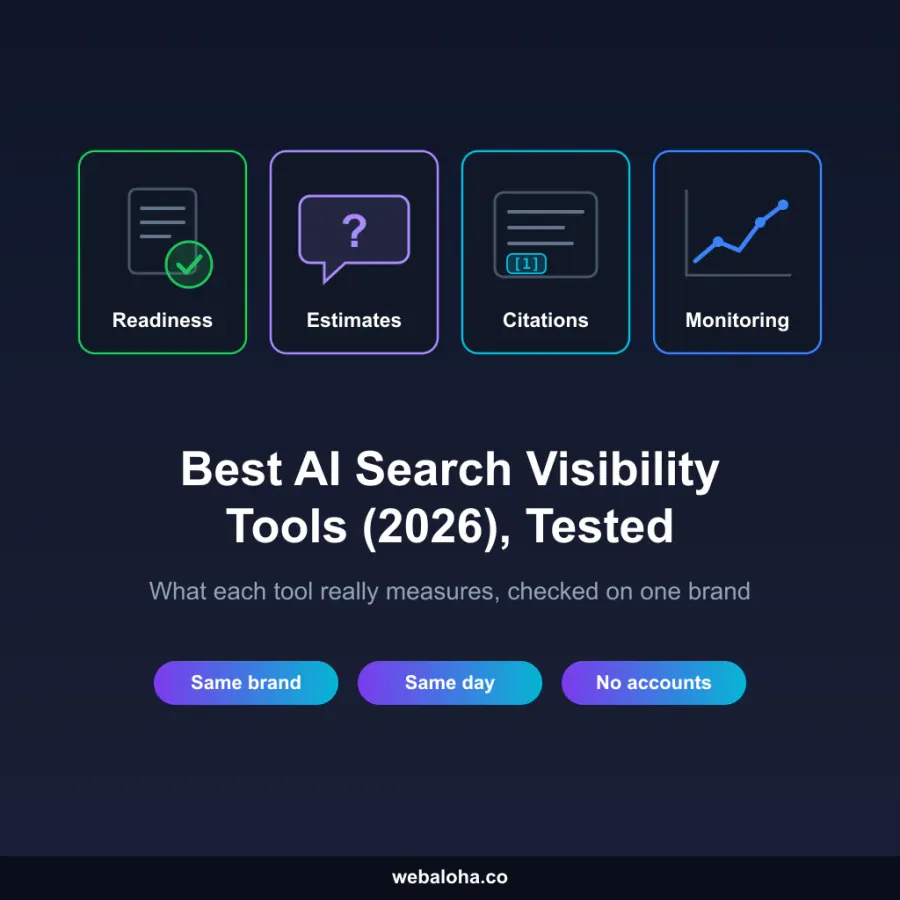
Our tested AI visibility tools comparison shows why a readiness scan, a sampled answer and ongoing citation tracking are different evidence.
Frequently asked questions
What is entity SEO?
Entity SEO is the practice of helping search engines and AI systems understand who you are as a named entity: your business name, what it does, who runs it, where it is located, and how it relates to other entities. Strong entity signals help AI systems cite and describe your business accurately.
Do brand mentions without links help with SEO and GEO?
A relevant mention can expose people to your business and provide source material. It is not equivalent to a backlink, and major AI providers do not publish a universal ranking or citation weight for unlinked mentions. Training data and current web retrieval are different processes.
What is NAP consistency and why does it matter for GEO?
NAP means name, address and phone number. Keep actual business facts accurate across your website and profiles so readers can identify and contact you. Cosmetic formatting differences alone do not prove an AI citation problem.
Do online reviews affect AI search visibility?
Reviews help customers assess a business and may appear in sources used by some products. Access and use differ by platform. A review count or score does not guarantee an AI recommendation or citation.
How do I get brand mentions for GEO purposes?
Earn brand mentions by creating genuinely useful content that others want to reference, doing digital PR outreach, getting listed in relevant directories and industry roundups, participating in community platforms like Reddit and Quora, and earning reviews on trusted sites. Guest posts, partnerships, and podcast appearances all generate brand mentions.
What is the difference between a backlink and a brand mention for GEO?
A backlink is a clickable reference that can support discovery and link analysis. A brand mention names the business without necessarily linking. Measure the referral or citation outcome; do not assign both the same search value.